FX Outlook 2026: what’s driving AUD and NZD volatility—and how businesses can reduce risk, protect margins, and improve cashflow certainty with better FX processes.


The Australian dollar (AUD) is entering 2026 caught between a softer US dollar narrative (as markets anticipate US Federal Reserve rate cuts later in the year) and ongoing global uncertainty driven by growth concerns and geopolitical risk.
The result: sharp, sentiment-driven swings that can feel disconnected from day-to-day business performance.
For businesses with offshore revenues, costs, or balance-sheet exposures, this creates a familiar challenge: currency markets can move fast, often without warning, and traditional forecasting alone may not be enough to protect margins and cash flow.
Both AUD and NZD remain “risk-sensitive” currencies—meaning they tend to react quickly to changes in global sentiment. In practical terms, that can mean outsized FX moves driven by offshore developments rather than local fundamentals.
Common triggers include:
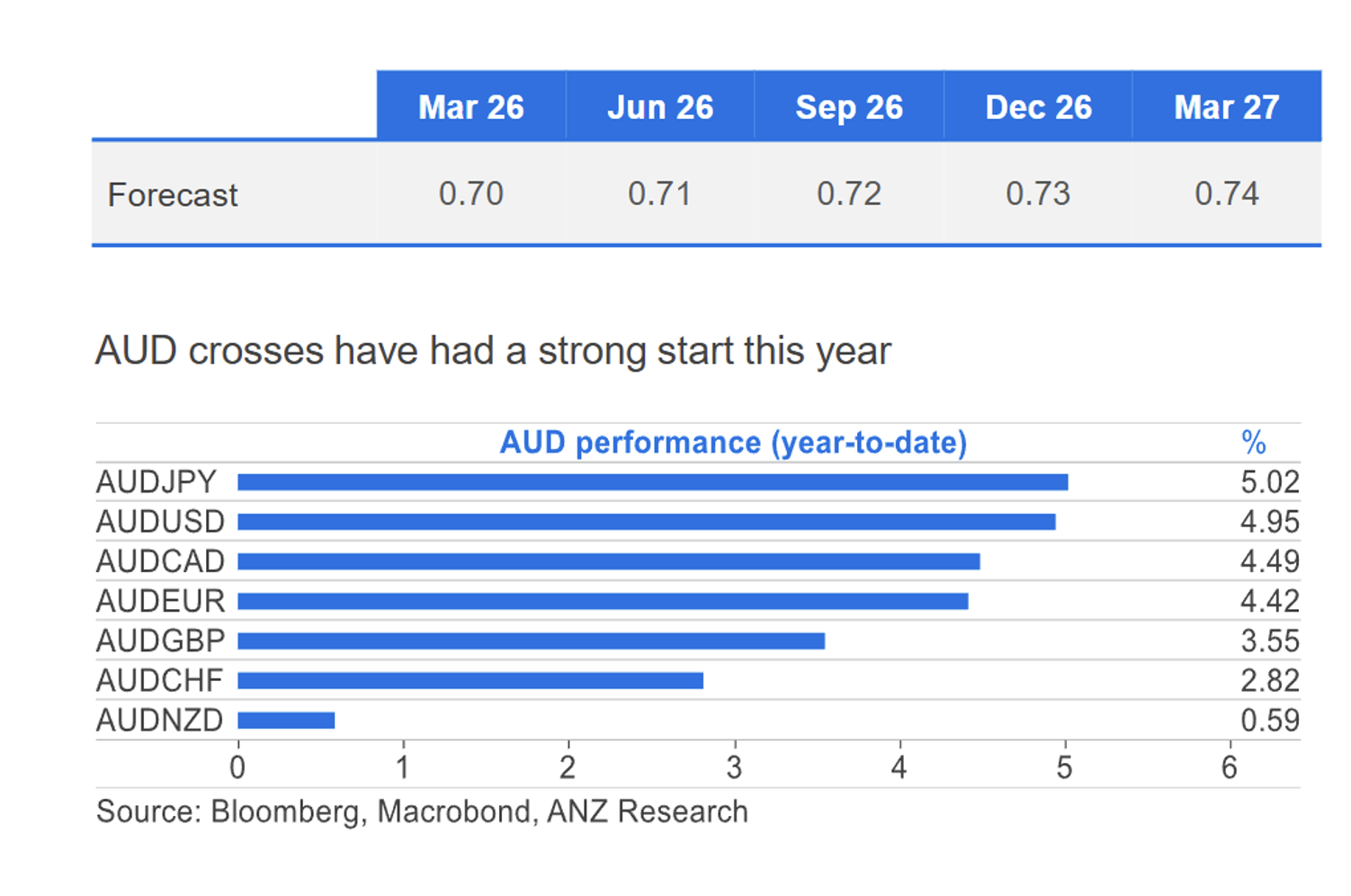
The AUD continues to trade like a “risk-on/risk-off” barometer, responding quickly when global markets shift mood. Even modest changes in Fed guidance or global growth expectations can cause disproportionately large moves in AUD over short periods.
Australia’s resilient labour market and the Reserve Bank of Australia’s cautious approach to easing can provide support at times—but only up to a point. Global markets often price AUD based on offshore developments first, and Australian conditions second.
Near-term, AUD is likely to remain range-bound—but with uneven volatility that’s difficult to time confidently. This is where margin pressure can creep in: currency moves can be sharp and unpredictable, even when underlying commercial performance is stable.

The New Zealand dollar faces many of the same global forces as the AUD, but with greater sensitivity to shifts in global risk appetite and growth expectations. Weaker domestic growth momentum and a more advanced easing cycle leave NZD vulnerable to underperformance—especially in “risk-off” periods.
If you operate across Australia and New Zealand (or have NZD costs/revenues), relative movements between AUD and NZD add another layer of complexity. It’s not only about where each currency trades in isolation—relative shifts can materially impact margin and cash-flow predictability.
In this environment, the key question isn’t just: Where will AUD or NZD be in 6–12 months?
It’s: What do currency moves mean for margins, pricing, and cash flow today?
Instead of trying to “beat the market,” leading businesses are increasingly focused on:
The goal isn’t to eliminate FX risk entirely—it’s to remove avoidable uncertainty from decision-making.
At Fluenccy, we see FX less as a trading problem and more as a data problem. Businesses that can clearly see how currency movements affect historical performance and future cash flows are better positioned to act decisively—without relying on perfect forecasts.
By analysing past transactions alongside future exposures, finance teams can:
As FX volatility becomes a persistent feature rather than an occasional disruption, visibility, control, and discipline become the real competitive advantages.
If 2026 delivers more of the same volatility, forecasting will remain imperfect. But businesses can still improve outcomes by shifting focus from predicting markets to controlling financial impact—through clearer exposure visibility and more disciplined FX processes.
Ready to take the guesswork out of AUD/NZD volatility? Log in to Fluenccy to map your exposures, see the real cost of currency moves, and get AI-backed guidance on the next best action—or book a quick demo and we’ll show you what you could save.