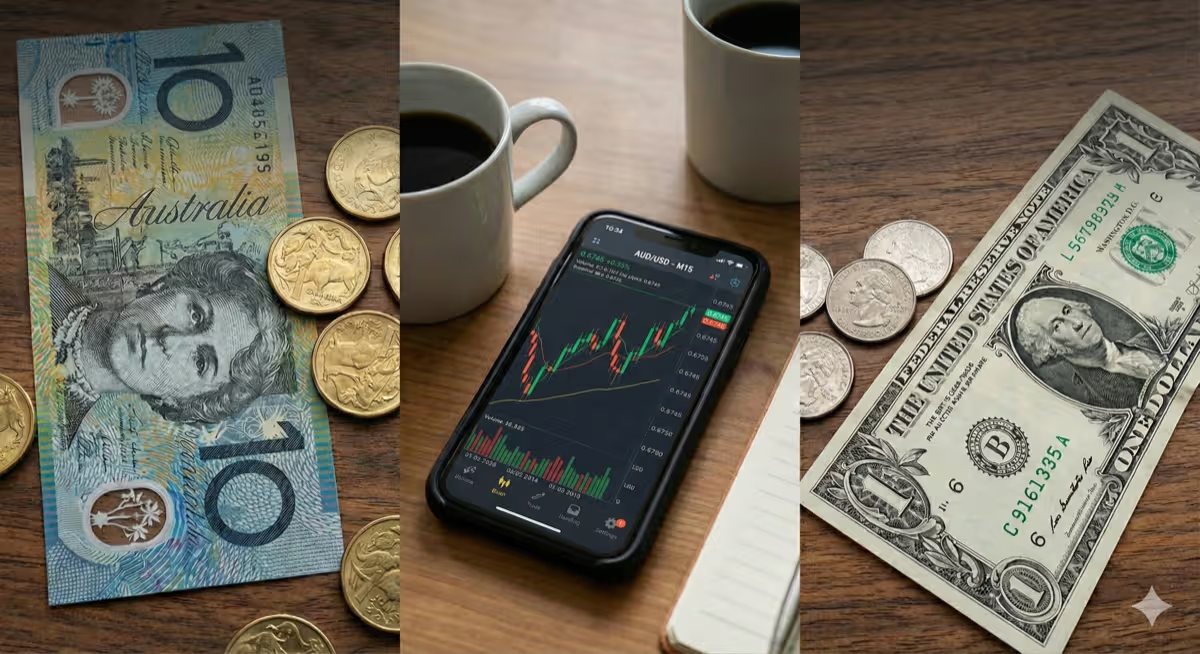
Your foreign currency account is losing value daily - you're just not watching. Discover why inaction on FX is still a position with real P&L consequences.
It's one of the most common things we hear from finance leaders. It's also one of the most expensive assumptions a business can make.
Let's start with the account. The one sitting quietly in your banking platform right now - denominated in USD, EUR, or whatever currency your major suppliers invoice in. The balance that hasn't moved in weeks because the invoices are paid and the next cycle hasn't started yet. That balance is moving in value every single day. You just aren't watching it. This is the FX paradox that sits at the heart of how many Australian and New Zealand importers and exporters manage - or more accurately, don't manage - their currency exposure. The feeling of safety isn't coming from an absence of risk. It's coming from an absence of information.
Foreign currency bank accounts are a practical necessity for businesses with international trade flows. They reduce conversion friction and provide a buffer against timing mismatches. The problem isn't holding them - it's forgetting that the value of what's inside them is in constant motion.
A USD balance worth A$850,000 on Monday might be worth A$831,000 by Friday. Not because you spent anything. Not because anything went wrong. Simply because the AUD/USD rate moved 2% - which it has done, repeatedly, across any rolling 30-day window you care to examine over the past five years.
.png)
The dollars are sitting still. The exchange rate is not. And the gap between those two realities is where unhedged FX exposure quietly erodes margin.
The natural hedge is the strategy most businesses default to without ever deciding to. It goes something like this, "We get paid in USD and pay in USD, so the currency risk cancels out." Or "We hold the currency and convert when we need to."
In theory, it's sound. In practice, it quietly underperforms by more than most CFOs realise.
Consider a business converting A$20M in foreign currency payments annually. A natural hedge approach - holding FX accounts and converting reactively typically results in conversion timing that misses optimal rates by 1.5% to 2.5% on average. At A$20M, that's A$300,000–A$500,000 in implicit FX costs that never appear on any invoice but absolutely appear in your gross margin.
The natural hedge also introduces a subtle but significant operational risk; it ties cash flow forecasting to rate movements that are entirely outside the business's control. When the AUD weakens sharply, the cost of paying overseas suppliers in a natural hedge structure rises, often at exactly the moment the business can least absorb it.
"A passive FX strategy isn't zero cost. It's a cost that's simply never been measured."
Here's the one that tends to land hardest in the room. Many finance leaders resist hedging because it feels like speculation, taking a view on the market. Committing to a rate before you know where rates are going. And fair enough, that’s not what a CFO is paid to do.
But here's what's worth examining carefully, not hedging is also a position. It is, in fact, a fully committed view that current or future spot rates will be at least as favourable as a hedged rate available today. It just doesn't feel like a decision because no one made it consciously.
Every day an exposure sits unhedged, the business is actively speculating, not by action, but by inaction. The P&L impact when rates move against you is identical whether you decided to leave the exposure open or simply never got around to covering it.
The question isn't whether to take an FX position, you already have one, the question is whether that position is deliberate, measured, and managed, or accidental.
What separates businesses that manage FX well from those that don't isn't the size of their treasury team. It's the presence of a framework that works whether rates move in their favour or against them. An active FX strategy typically combines three elements;
Rate certainty on known exposures, forward contracts allow businesses to lock in an exchange rate for future payments, converting a variable cost into a fixed one and giving the finance team genuine visibility over margin. This isn't speculation; it's forecasting discipline applied to FX.
Optionality where the future is less certain. Where order volumes or timing are harder to predict, options structures allow a business to set a worst-case rate floor while preserving the ability to benefit if rates move favourably. This is the tool that addresses the "but what if rates improve?" objection to hedging.
Real-time intelligence to inform timing decisions. Not every conversion needs to be locked in months out. But every conversion decision should be made with live market context; rate alerts, volatility signals, and forward rate curves rather than a quick glance at a banking app.
The goal isn't to beat the market. It's to remove the market as a variable from your cost of goods. Businesses that do this consistently report narrower margin variance, more accurate budgeting, and significantly less time spent on reactive FX conversations at month-end.
Most businesses only take FX seriously after a bad quarter. A rate move that compressed margins by 3 points. A supplier invoice that landed 8% higher than the budget assumed. A board conversation no one wanted to have. The FX review that follows that conversation is an autopsy. Useful, but too late to change the outcome.
The alternative and it is available right now, to any business with meaningful FX exposure is a pre-emptive examination. Understanding what your actual exposure is. Quantifying what a 2%, 4%, or 6% rate move costs your business. And putting a structure in place that means the next rate movement is a non-event rather than a crisis. You don't have to wait for something to go wrong to start managing this well.
Fluenccy helps Australian and New Zealand importers and exporters build active FX management frameworks - combining smart forwards, options structures, and real-time rate intelligence in a single platform. If your business has annual FX exposure above $5M and you're currently managing it reactively, it may be worth a conversation. Learn more at www.fluenccy.com